
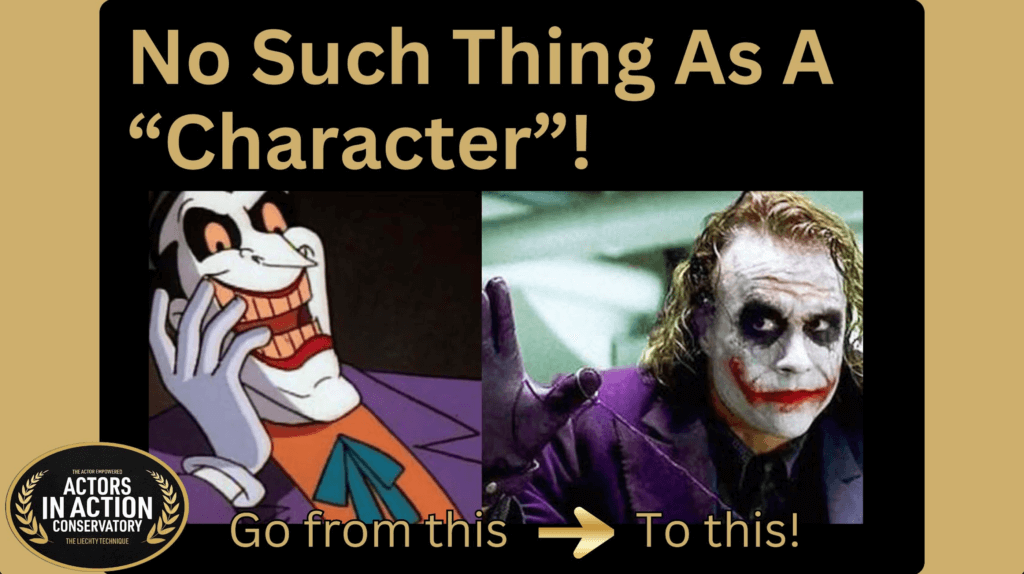
For as long as acting schools have existed, actors have been told to “build a character.”
Create a backstory.
Invent a personality.
Layer on quirks, choices, “character work,” and all the little psychological decorations that supposedly make someone “interesting.”
But here’s the radical truth — the one that changes everything the moment you truly absorb it:
There is no such thing as a character.
There is only YOU, playing specific behaviors that create the illusion of another person.
That’s it.
That’s the magic trick.
When actors finally understand this, their entire craft cracks open. Acting stops feeling confusing, pressured, or performative — and suddenly becomes liberating, embodied, instinctive, and deeply human.
This blog is about why and how to start working this way in your training, your auditions, and every single role you will ever play.
THE MYTH OF “CHARACTER” AND WHY IT BREAKS ACTORS
Most actors struggle not because they lack talent — but because they’re fighting a losing battle:
They’re trying to create a “character” instead of learning truthful behavior.
When you try to become someone else, you immediately:
- leave your body,
- jump into your head,
- tighten your ribs,
- lose your breath, and
- start “presenting” instead of behaving truthfully.
And you can feel it.
The audience can feel it.
Casting can feel it in two seconds flat.
And it’s a total turn off.
When actors describe feeling “stiff,” “insecure,” “fake,” “disconnected,” or “like the lines aren’t coming alive,” it’s usually because they’re trying to play someone rather than do something.
Actors are not only storytellers — actors are behavior artists.
And behavior only comes from one place: your own human instrument.
THE TRUTH: “CHARACTER” IS JUST BEHAVIOR
Every believable actor you’ve ever admired — Meryl Streep, Gary Oldman, Daniel Day-Lewis, Tilda Swinton — isn’t creating a character out of thin air. They are using their bodies, their imagination, their emotional pathways, theirimpulses . . . and then adjusting their behavior.
That’s it.
Here’s the simplest equation you’ll ever learn as an actor:
YOU + specific behaviors = the illusion of a different person.
And what exactly is behavior?
It is intent + movement.
It is taking action (movement) to get what you want (intent).
And the best part?
It feels good.
It feels clean.
It feels human.
It feels possible.
Actors breathe again.
They can actually listen again.
Their imaginations wake up again.
This is the kind of acting casting directors remember.
VERBS: THE ENGINE OF BELIEVABLE BEHAVIOR
If “character” isn’t real…
Verbs absolutely are.
Playing verbs creates behavior.
Behavior creates story.
Story creates the illusion of a different person.
This is why I say in class — constantly — that verb work is intimate.
It exposes you.
It opens you.
It activates your body.
It makes you feel naked emotionally.
Because when you “play a verb,” you are literally doing something to your partner to get what you want.
To persuade.
To soothe.
To poke.
To warm.
To test.
To disarm.
To seduce.
To measure.
To break.
To uplift.
These are specific.
They create specificity in your body — in your voice, your breath, your movement, your focus.
When your verbs are clear, you don’t have to “act.”
The behavior emerges organically.
As I tell my students:
If your verbs are clear, your acting will be clear. We will be able to see into your soul. We will be moved.
Character will never save you.
Verbs always will.
DRAMATIC BEHAVIOR: THE PATHWAY THAT MAKES SCENES COME ALIVE
Every scene ever written — from Shakespeare to sitcoms — follows the same fundamental structure:
- Someone wants something.
- There is an obstacle.
- They push against it to get what they want.
- That pushing creates dramatic behavior.
- Dramatic behavior creates story.
If you strip acting down to its bare bones, this is all drama truly is.
Acting is the art of pushing against obstacles using behavior all while in an imaginary circumstance.
Most beginners think acting is about:
- emotions
- emotional recall
- hitting the lines
- memorizing
- “character choices”
- indicating meaning
But acting — real acting — is the art of dramatic behavior.
This is why I say it’s like “learning to see the wind.”
You can’t describe it in words.
You have to do it.
Once you feel it, it changes you.
And once you learn how to use verbs to push through the obstacle…
You start acting in a way that makes audiences feel something in their gut.
WHY SO MUCH ACTING FEELS FAKE — AND WHY AIAC TRAINS THE OPPOSITE
Actors who “create characters” tend to rely on:
- ideas
- concepts
- psychology
- quirks
- mental images
- line readings
- emotional memory
- backstory
- “pretending”
But the audience can’t feel concepts.
They can’t feel your backstory.
They can’t feel your choices.
They feel behavior.
At AIAC you learn:
- how to send energy forward into your partner,
- how to make them feel something,
- how to listen so well that you adjust on a dime,
- how to keep verbs active and physical,
- how to root your behavior in your own humanity,
- how to stay in your body instead of your head,
- and how to let drama live in your body, breath, and impulses.
This is why AIAC actors book.
This is why they stand out.
This is why your acting looks alive compared to most of what’s out there.
ENTITY WORK: THE INTERNAL LANDSCAPE THAT SUPPORTS THE VERBS
“Entities” are a form of personalization work I created for my technique. They help you viscerally connect to the roles opposite you in the scene. They stir your feelings and create the relationships you have with your scene partners. And it is one of the most powerful skills I teach.
Entities trigger somatic states that live in your body.
They are NOT “emotional memories.”
They are NOT psychological narratives.
They are:
- breath patterns
- temperature changes
- physical sensations
- posture shifts
- chest constriction or opening
- energy scattering or grounding
- the feeling of being hopeful, disillusioned, frantic, frozen, cracked-open
Entities help trigger the right internal state so your verbs have the right emotional quality behind them.
Think of entities as the color of the behavior.
Verbs = structure
Entities = tone
Effort Shape = physicalization
Voice Work = resonance & expression
Forward Motion = energy & motivation
Listening = responsiveness
Obstacle = purpose
Together, they give you more expressive range than “character work” ever could.
WHY THIS APPROACH TAKES TIME — AND WHY IT’S WORTH IT
Learning to act this way is not instant.
I tell students constantly:
“This will take months. It will take years. But once it clicks, your acting changes forever.”
Because what you’re learning is a technique.
It’s not a trick.
It’s not a gimmick.
You’re learning:
- how to be in your body
- how to use your humanity
- how to regulate your nervous system
- how to send energy into your partner
- how to behave truthfully under imaginary circumstances
- how to let the audience feel your forward motion
- how to work obstacles
- how to let behavior drive everything
Once this becomes your baseline, you don’t “create characters.” You simply adjust your behavior and the audience comes with you.
It’s the closest thing to magic the craft has.
SO… HOW DO YOU START TRAINING THIS WAY?
Start here:
1. Play your verbs BIG at home.
Ridiculously big.
Get them into your body.
Feel what each verb does to your ribs, breath, face, hands, and impulses.
2. Watch playback not for lines — but for BEHAVIOR.
Did you make me feel?
Did your behavior push against something?
Did your verbs land?
3. Work your entity sensations before you tape anything.
Breath. Images. Kernels. Scenarios.
Whatever hooks you in — train it.
4. Practice distracted repetition.
It teaches you to stay connected while staying natural — the way real people behave.
5. Use forward motion every time.
Send energy into your partner, into the space, into the world of the scene.
If they can feel you, you’re acting.
6. Voice work.
This will change your acting more than almost anything else.
Your voice is your instrument.
7. Train consistently.
Conditioning is EVERYTHING.
As I say in class:
“If you can’t handle AIAC, you can’t handle professional acting — because it only gets harder.”
This training fits you for the profession.
THE PAYOFF
When you drop “character” and start working with:
- verbs
- behavior
- dramatic pathway
- entities
- effort shape
- voice
- forward motion
- nervous system grounding
- genuine impulse
- listening
- somatic truth
…your acting becomes:
✨ Clear
✨ Grounded
✨ Specific
✨ Dynamic
✨ Present
✨ Embodied
✨ Emotionally alive
✨ Unpredictable
✨ Truthful
This is the acting casting directors hunger for.
This is the acting audiences feel in their gut.
This is the acting that books work across the U.S., the U.K., Canada, Australia — everywhere.
Why?
Because the truth is universal.
And YOU — your body, your history, your humanity — are the instrument.