
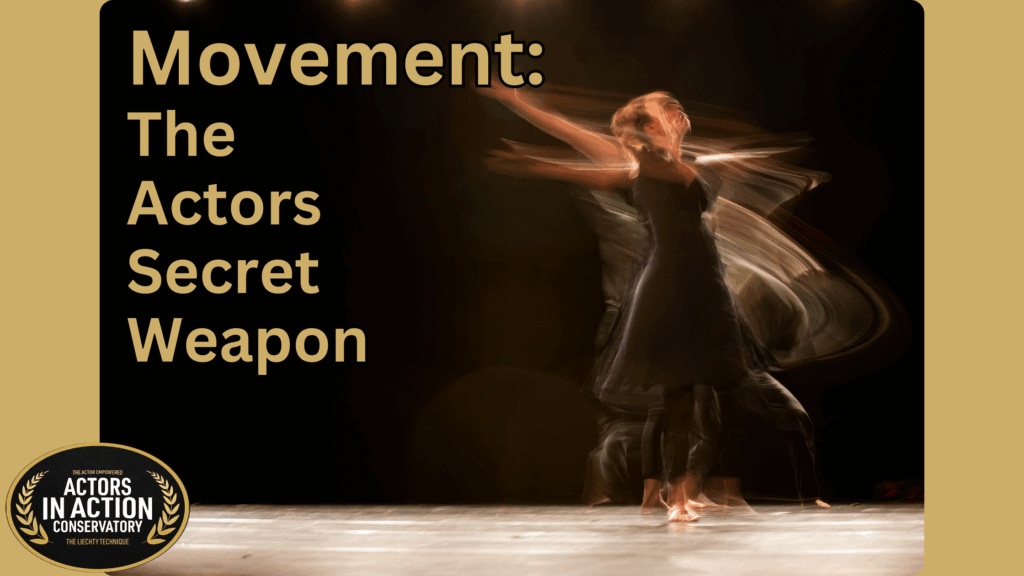

Movement and the Actor – Why Your Body is Your Greatest Tool
A lot of actors think how they say their lines is the most important thing they can do. Guess what? That’s not really true. Of course, you want to connect to the words of your character, get them out clearly, and communicate them meaningfully — but communication is so much more than just saying words. It’s your body language, the tone and timbre of your voice, the emotional quality you exude… it’s so much more. And ALL of it is based on: MOVEMENT.
When I got my BFA at DePaul Theatre School, all four years we had movement classes — three times a week. We were rolling around on the floor, imitating animals, throwing balls at each other, dancing to drums. It was wild. One of the movement studies we explored was Laban’s Effort Shape. In it, you learn to move your body (and your voice) in ways you normally wouldn’t. I quickly realized it was a way to build a character — to become “another creature.” Like Gollum, a fairy princess, or an alien from outer space. I began to see how useful it was not only for big and bold roles, but also for winnowing down into simpler movements, allowing my everyday characters to take on specificity and distinctness.
Can you imagine auditioning for another cop or secretary role and REALLY wanting to stand out, but you just don’t know how? If you were to put just a little bit of movement — a kind of “signature” — into your role, you might catch the eye of casting and rise above the herd of other actors submitting for the same part.
So many actors limit themselves to their same old movement, their same old way of playing roles, because they don’t understand the magic of movement.
Don’t be one of those actors.
Another way to get in touch with your body and incorporate movement specific to your role is Lessac’s Body NRGs. Based on the natural pain relievers our bodies gravitate to — breathing, yawning, shaking — these NRGs relax, release, and activate the actor. They’re called Buoyancy, Radiancy, and Potency. Exploring the text of a scene using these three can connect it deep into your muscles and cells, your mind and your soul. It aids memorization and helps you communicate with ease and impulse.
Using movement also helps tremendously with breaking habits — vocal patterns, tension, emotional blockages, even anxiety.
I recently attended the Utah Shakespeare Festival in Cedar City, Utah. For one week during their season, the Royal Academy of Dramatic Arts (RADA) sends over a show. This year they did Twelfth Night. I took one of my AIAC students to see it because their acting is absolutely brilliant. Although I love the other shows at USF, the RADA one always stands out.
My student and I went to the “talkback” with the cast after the show, and they mentioned that during the first year of their three-year training program, the focus is on discovering how they move, talk, speak — everything that makes them tick. Once they become consciously aware of their habits, they can let go of any blocks or limitations and work from a place of freedom while developing characters. They learn to walk, talk, move, think, and behave as people completely unlike themselves. That deep “character work” is the focus of their second year of training.
They do all of this through movement — of the body, voice, emotions, thought, behavior. And the result is mesmerizing. Next year, I’m taking as many of my students to see them as I can.
AIAC isn’t a three-year program — our training is ongoing — but we are also a conservatory. And what we teach here is taught at RADA. Perhaps with slightly different approaches and techniques, but basically, as with all great acting training, we teach actors to free themselves to play any role they desire with truthfulness and passion. And we do it through the use of movement, voice, and behavior.
Want to see how we train? Watch this video!
Effort Shape Helps Book Netflix!
One of our students just booked a role on a Netflix series. In it, she had to embody a well-established character played by a very famous actor. Every move had to be precise, every inflection in tune with the original performance. It was an unusual role — and she later told me she would never have been able to book or perform without her AIAC training, especially her work with Effort Shape and the Lessac Body NRGs.
Even better? This was her very first booking with her new LA agent. Needless to say, we were all thrilled — Netflix included.