
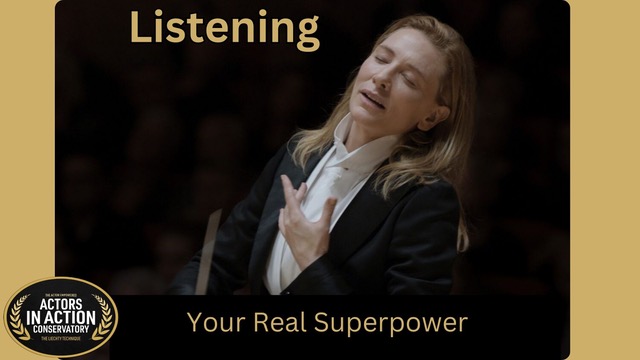
Your Real Superpower
Why Listening Is the Skill That Separates Good Actors from Great Ones
There is a moment in every truly compelling performance where the actor disappears and something real takes over. The eyes change. The breath shifts. The body responds before the mind can interfere. That moment is not created by emotion, clever line readings, or strong choices. It is created by listening. Real listening is one of the most powerful and least understood skills in acting, and it sits at the center of truthful scene work, authentic connection, and magnetic acting presence. At AIAC, listening is not a concept — it is a trained, embodied behavior.
What Listening Actually Is (and What It Is Not)
Listening in acting is not passive hearing, waiting for your cue, or politely absorbing information until it is your turn to speak. It is not nodding, reacting on time, or “looking engaged.” True listening is an active, physical, nervous-system-based response to your partner that alters you moment to moment. It is the willingness to be affected. Listening is the mechanism through which connection, reactivity, and truthful behavior emerge. Without it, acting becomes planned, self-focused, and emotionally disconnected — no matter how skilled the actor may appear.
Why Most Actors Think They’re Listening (But Aren’t)
Most actors believe they are listening because they are focused, attentive, and emotionally invested in the scene. But attention is not listening. Focus is not listening. Preparation is not listening. Actors often listen from the head — tracking lines, beats, objectives, and emotional intentions — while their bodies remain insulated from impact. True listening happens below thought. It occurs when the nervous system is available, the body is responsive, and the actor allows the partner to genuinely influence breath, sensation, impulse, and behavior.
Listening Is a Physical Skill, Not a Mental One
Listening lives in the body. It shows up as a shift in weight, a change in breath, a softening or bracing of the torso, a micro-adjustment of energy or posture. When an actor is truly listening, their body responds before they choose how to respond. This is why listening cannot be faked or indicated. It must be trained. At AIAC, listening is developed through body-based acting techniques that condition actors to remain open, present, and responsive under pressure — especially in emotionally charged scenes and auditions.
Why Listening Creates Truthful Scene Work
Truthful acting is not about expressing emotion; it is about being impacted. When an actor is genuinely listening, they do not need to manufacture feeling. Emotion arises naturally as a byproduct of being affected by another human being.Listening heightens stakes, sharpens objectives, and makes behavior specific. It pulls actors out of internal performance mode and anchors them in shared reality. Scenes stop feeling rehearsed and start feeling alive because the actor is no longer alone in their head.
The Biggest Listening Mistake Actors Make
The most common listening mistake actors make is reacting instead of receiving. They prepare responses, plan emotional turns, or decide how they will feel before their partner finishes speaking. This creates timing that feels correct but energy that feels dead. Real listening delays certainty. It creates unpredictability. It allows the moment to land fully before the body responds. As I often say in class, “If you already know what you’re going to do, you’re not listening.” Listening requires risk — and that risk is where truth lives.
Listening on Camera: Why It Reads as Presence
On camera, listening is everything. The lens magnifies internal life, and nothing reads louder than a present, responsive actor. Subtle listening shows up as micro-reactions, energetic shifts, and emotional availability that captivates casting directors. This is why an actor can appear to be “doing nothing” and yet be completely compelling. That “nothing” is active listening — a nervous system engaged, tracking, and responding in real time. Camera acting is not about minimizing behavior; it is about maximizing receptivity.
Listening in Scene Study and Rehearsal
Without trained listening, scene study becomes mechanical. Actors hit their lines, execute choices, and wait for moments they have already planned. When listening is prioritized, rehearsal transforms. Partners become vivid. Timing changes organically. Impulses surprise the actor instead of being forced. Objectives sharpen because the partner is actually in the way. Listening turns rehearsal into discovery rather than repetition, and scenes deepen with each run instead of flattening.
How AIAC Trains Listening (The Liechty Technique)
At AIAC, listening is trained through a combination of repetition work, Effort Shape, emotional muscle development, and verb-based behavior. Actors are conditioned to stay open under stimulus, tolerate sensation, and allow their partner’s behavior to affect them physically before responding. These listening drills focus on receiving rather than reacting, tracking changes in energy, and allowing impulses to arise organically. This is not about being nice or agreeable — it is about being permeable and responsive while still pursuing strong objectives.
Why Listening Makes Your Acting Unpredictable (In the Best Way)
Actors who truly listen cannot be boring. Because they are not repeating rehearsed behavior, their performances remain alive, spontaneous, and specific. Listening disrupts habits, interrupts safety patterns, and forces the actor into the present moment. This is why listening-based acting feels fresh even after multiple takes or performances. The actor is not recreating results — they are staying available to the moment as it unfolds.
Why Listening Accelerates an Acting Career
Casting directors, agents, and directors consistently respond to actors who listen well — even if they cannot articulate why. These actors feel grounded, present, connected, and emotionally available. They play well with others. They elevate scene partners. They adjust quickly. They feel real. In an industry flooded with technically capable performers, listening is what makes an actor stand out. It is not flashy, but it is unmistakable.
Final Thoughts: Listening Is Not Optional
Listening is not a soft skill. It is not intuitive. And it is not something you either “have” or don’t. It is a trainable, physical, professional acting skill — and one of the most powerful tools an actor can develop. If you want more truthful scene work, stronger on-camera presence, deeper connection, and performances that actually land, listening must be trained deliberately and consistently. At AIAC, listening is not just encouraged. It is required — because it is the foundation of real acting.