
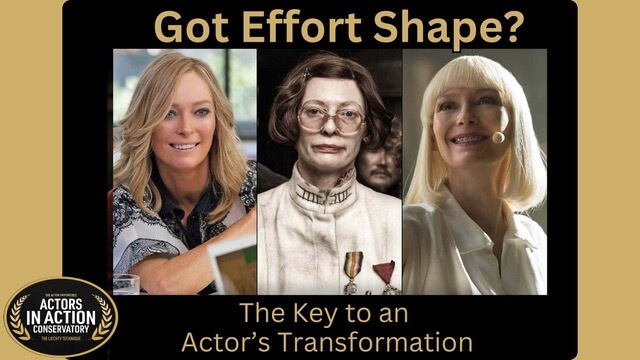
At AIAC, we use Laban’s Effort Shape to shape characterization—by changing the way we move and speak, we can appear to be entirely different people. Great acting originates from the self, not from “building a character.” Character emerges through behavior and is deeply shaped by your verb choices. Characterization, on the other hand—the way we move and speak differently than we normally do—stems from physical movement itself. When we discover new ways of moving our bodies and using our voices—combined with a deep connection to ourselves and our true humanity—we naturally transform into “another creature” when we act.
Effort Shape is a study of movement used in acting and dance that was created by Rudolf Laban in the early part of the 1900s. It is what we use at AIAC as the basis of our character work, or becoming “another creature” through changing the usual way we move our bodies and voices. Yes, you can “move” your voice!
If you know my technique, I’m not big on playing a “character.” Meaning, I believe your acting should come from you—from your humanity—not from trying to be someone else. But once an actor learns how to act from themselves, they may want to begin transforming their physicality to appear as a different kind of person—one that more fully fits the role they are playing. A different cadence in the voice. A different walk. Different mannerisms. I’m talking about becoming a chameleon actor.
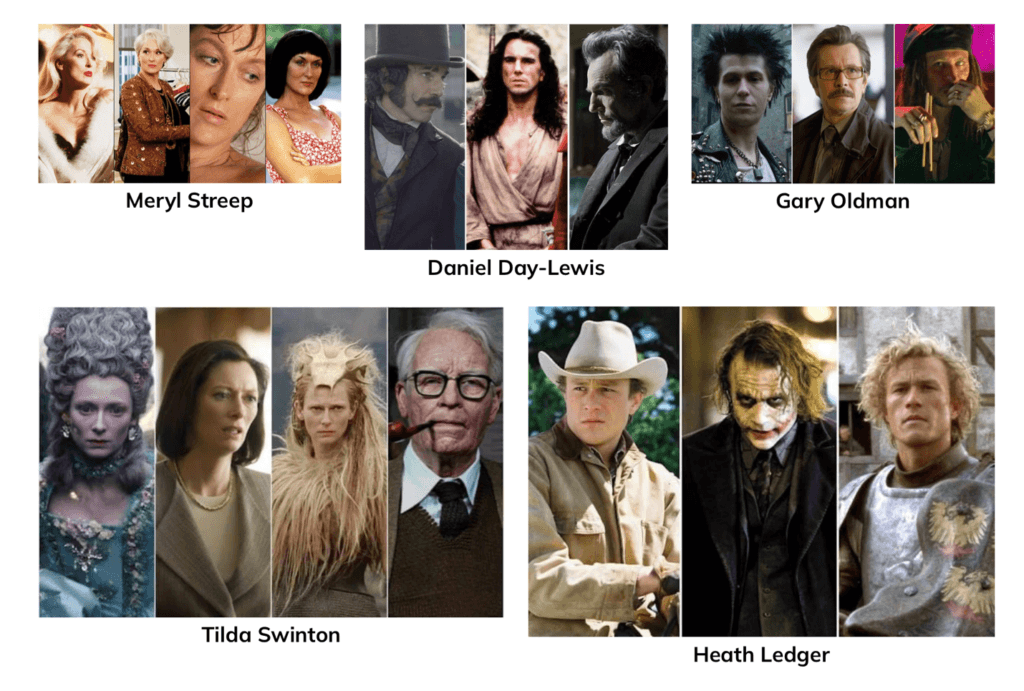
Think of the great actors who transform completely with each role—Daniel Day-Lewis, Tilda Swinton, Gary Oldman, Heath Ledger, Meryl Streep. Their performances are captivating because they come from the truth of who they are, yet are filtered through the unique movement and voice of “someone else.” This kind of transformation is exactly what Effort Shape helps us achieve, which is why we begin working with it early in our training.
Each of these actors transforms themselves through movement and voice to become so different from their normal selves that it amazes us as viewers. It seems like they have superpowers. They really don’t—except in that they have become highly skilled at changing the way they move and sound. Effort Shape, and mastering it in practice, will give you that same ability.
So where do we start?
When I take my students through an exploration of Effort Shape, we begin by working through the six different types of movement found in nature. I have them walk around the studio space first indirectly—like a leaf being blown by the wind, meandering, without direction or purpose. Then we switch to direct movement—knowing exactly where we are going, even if we are moving backward. Feeling the difference between these two is a great start.
Next, we move into strong movement. “You’re super heavy or super strong,” I tell them. “Like you’re pushing through cement.” Then we move into lightness—moving around like you’re a feather or suspended in water. Light, light, light.
Then we switch into quick movement. “Like a ninja!” I’ll call out. People begin moving frenetically through the space—quick, sharp movements. Finally, we move into sustained movement, meaning there are no breaks in our movement. Everything is connected and flowing.
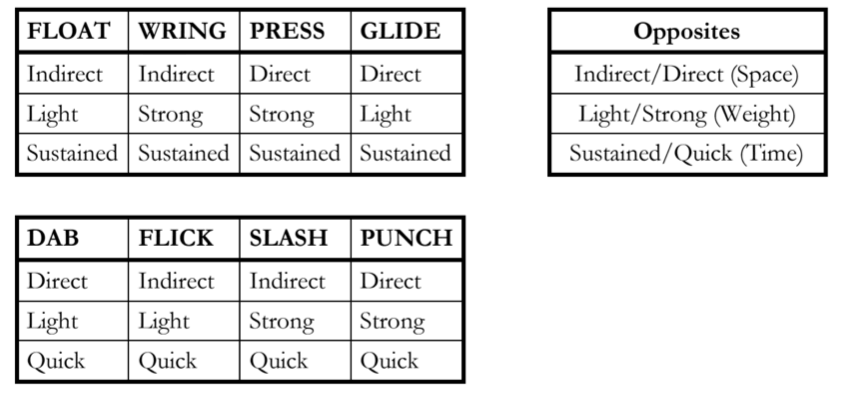
After we’ve experienced the six different types of movement, we begin working with an Effort Shape. Each Effort Shape is a combination of three of the six movement qualities. Wring is indirect, strong, and sustained. Press is direct, strong, and sustained. Flick is indirect, light, and quick, and so on. (See the chart below for the full Effort Shapes.)
When we explore the actual Effort Shapes, we’ll pick a piece of music that supports the one we’re working with. For example, for Press, I often like to use a dramatic piece of music from The Lord of the Rings. I’ll put it on and we’ll move, letting the music support and inspire us. Music can be incredibly helpful in Effort Shape work—it’s a mood enhancer, and you’ll notice that moving your body in these specific ways often evokes emotions and internal mood states.
You may also notice that certain Effort Shapes live more strongly in specific parts of your body. For example, when I do Glide (direct, light, sustained), I feel it particularly strongly in my sternum.
Once we’ve explored about three different Effort Shapes, I’ll then have my students pick one to “subtle up” into a character walk. If they choose Press, for example, they’ll move around the space with just a hint of Press in their stride, their posture, and their attitude. We want this walk to be subtle—toned down to a film level, or slightly more pronounced if we’re working on a theatre role—but not nearly as big as our earlier explorations.
Then we’ll take a break and process what we discovered through writing. I’ll have them jot down anything in particular they noticed about the Effort Shapes: where they felt them in the body, whether they triggered imagination or transported them into a different environment, what emotions arose, and where those emotions live physically.
This way, later on, if they are working on a role and want to evoke something they discovered earlier, they can return to their notes and draw from them. For example, if I’m playing a character with a lot of Glide, I might remember that I feel Glide in my sternum. All I need to do to evoke it is reconnect to that sensation, and suddenly I’m in Glide again.
Applying Effort Shape
When you’ve mastered the flow of Effort Shape and it’s time to start integrating Effort Shape into your acting work begin by taking your script and choosing one Effort Shape to explore. If you’re unsure where to start, choose one at random from the chart above.
· Choose your Effort Shape (e.g., Wring, Press, Dab, Flick, Slash, Float, Glide, Punch).
· Select music from the playlist that corresponds with that Effort Shape.
· Move and speak your lines while staying inside the chosen Effort Shape.
Allow the music to guide your impulses and help you discover new physical and emotional textures. Don’t worry about being “right.” Explore extremes first, then refine into subtlety. Afterward, move on to another Effort Shape and repeat the process with new music.
As you explore, ask yourself:
· How does this Effort Shape make me feel?
· How does it change my movement and my thoughts?
· Do new verbs, images, or Life List entries come to mind?
· Does this Effort Shape fit my role—or reveal something unexpected?
You may discover that one Effort Shape becomes your primary (or “major”) and another your secondary (or “minor”). Notice how each influences different moments of the scene. Even Effort Shapes that initially seem mismatched can offer valuable insight—perhaps revealing humor within darkness or weight within comedy.
Once you’ve explored all the Effort Shapes in your scene, jot down what you discovered—sensations, imagery, breathing rhythms, or impulses. These can become touchstones or triggers to help you re-access that physical and emotional life later.
When you’ve identified your major and minor Effort Shapes, rehearse the scene again—first going big, then refining. See if you can anchor the work through rhythm, small gestures, or recurring movements that keep the Effort Shape alive in your body.
Effort Shape reminds us that truth lives in the body. When we free the body, we free the voice. When we free the voice, we free the self. And from that freedom, character naturally emerges—not as something we “build,” but as something we become.
At AIAC, this is at the heart of our work: developing actors who can embody the full range of human experience with honesty, depth, and fluidity. Effort Shape is one of the tools that allows you to bridge the gap between who you are and who you can transform into—without ever losing connection to your truest self.
BONUS
Get a taste of what we do in Class.
Here’s a Bonus Gift for you:
Our Effort Shape Warm Up Video.
Join us in this video to get a taste of Effort Shape and see how we work in class.
For more information about our training visit: www.actorsinactionconservatory.com