
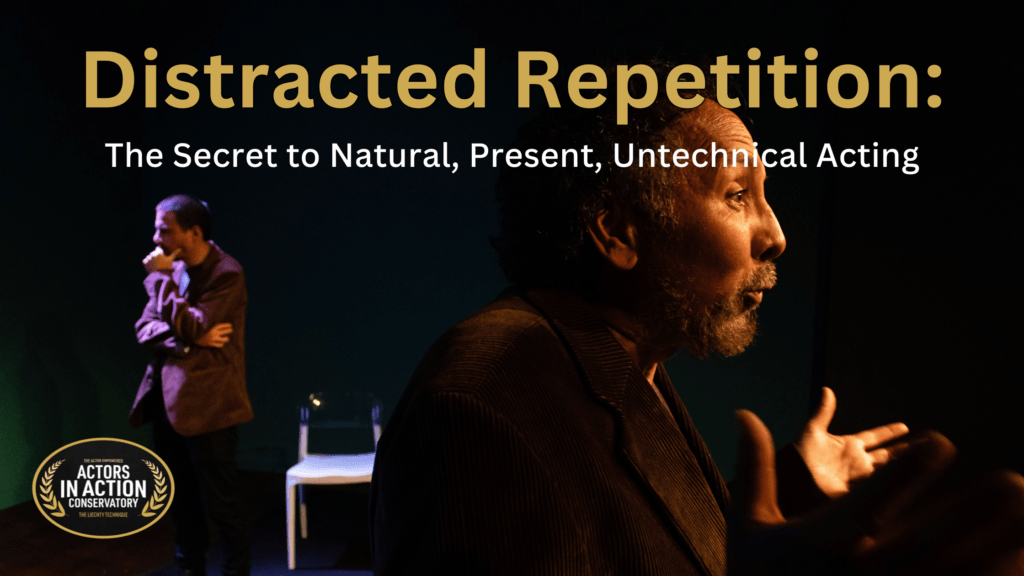
If you’ve been in an AIAC class lately, you’ve done Distracted Repetition. And if you’ve done it with me, you’ve probably heard me laugh and say:
“This is how we ACT in real life.”
Distracted Repetition is one of those deceptively simple acting exercises that looks easy until you realize how much your brain wants to control everything. It forces you to listen while also dealing with something else, and it reveals exactly how actors break presence without even realizing it.
It’s one of my favorite tools because it solves a HUGE problem in acting:
Actors think being “focused” means staring intensely at their partner.
Meanwhile, real humans rarely stare at anyone for long… because we live in distraction.
Distracted Repetition frees actors from “actor behavior” and puts them back into actual human behavior. And when you understand that, your acting opens up.
This blog breaks down what Distracted Repetition is, why it’s powerful, and how to apply it in your training.
WHAT IS DISTRACTED REPETITION?
It’s simple:
In class, I said, “When we’re acting, we’re still connected to our partner, but we’re not going to stare at them the whole time. If we do that, it doesn’t look too natural.”
The goal is presence in chaos, which is what acting really is. You don’t freeze in your body or slip into “actor mode.” You stay involved with your partner while doing something else, just like you would in real life.
WHY DISTRACTED REPETITION IS SO POWERFUL
⭐️ 1. It breaks the “actor stare.”
Beginners tend to fix their eyes on their partner like a laser beam because they think that’s what good acting looks like. The harder they try to look like they’re listening, the more forced the performance becomes.
Distracted Repetition teaches:
Your body relaxes, your face softens and your listening becomes real.
⭐️ 2. It builds real sensory availability.
When you’re distracted, you don’t have time to think your way into emotions.
You have to trust your impulses, your reactions, your partner, and your body.
Over time, that retrains actors to stop indicating emotion and simply respond to what’s actually happening.
⭐️ 3. It helps you act like a real person.
Real life is full of divided attention.
We have conversations while making coffee, folding laundry, driving somewhere, or searching for our keys. Our attention shifts naturally, but we stay connected to the people around us.
Distracted Repetition helps actors bring that same behavior into their work.
⭐️ 4. It removes self-consciousness.
The distraction gives your brain something else to do.
You stop monitoring yourself and worrying about how you look.
Before long, you’re paying more attention to your partner than to yourself, and that’s where truthful acting begins.
⭐️ 5. It strengthens listening.
This is HUGE.
In class, I said:
“Listening — checking — is how we gauge our partner’s behavior so we know how to respond.”
Distracted Repetition builds listening by forcing you to:
Keep one ear open → take in what your partner says → let it affect you → then react honestly
You get better at absorbing behavior, not just repeating words.
⭐️ 6. It creates unexpected moments
When you’re distracted, your reactions become:
→ Actors LOVE control.
→ Audiences LOVE unpredictability.
Distracted Repetition bridges that gap.
THE AIAC APPROACH TO DISTRACTED REPETITION
Most acting programs use some form of repetition. At AIAC, we use it as a way to develop truthful behavior, not simply to repeat words or practice “being present.” Every repetition has a purpose, and that purpose is to strengthen the habits that create believable performances.
Our focus is always on:
✔️ Behavioral truth
✔️ Organic listening
✔️ Forward motion
✔️ Physical presence
✔️ Impulse-driven play
That’s what makes Distracted Repetition more than an exercise. It’s training for the way real people behave, which is exactly what great acting requires.
HOW TO DO DISTRACTED REPETITION CORRECTLY
Here’s your step-by-step AIAC version:
STEP 1 — Pick a distraction
It can be:
Keep it real, natural and human.
⭐️ STEP 2 — Start repetition
Let your partner say something simple:
“You seem tired.”
“You’re excited today.”
“You’re quiet.”
“You’re focused.”
And repeat it back.
⭐️ STEP 3 — Let the repetition shift naturally
✖ Don’t perform.
✖ Don’t “add ideas.”
✖ Don’t make it interesting.
Let the behavior do the work.
⭐️ STEP 4 — Stay connected even while distracted
In class, I often say that checking is another way of saying listening.
You’re not keeping your eyes locked on your partner the entire time. You’re staying aware of them. You check in, notice their behavior, and let it affect you before your attention naturally returns to the task at hand.
Checking = Using your eyes + body + attention to take in your partner’s behavior.
Even when you look down, you still feel them.
⭐️ STEP 5 — Let your impulses lead
If you suddenly laugh?
Great.
If you suddenly get annoyed?
Great.
If you shift your body?
Great.
You are allowed to be human.
⭐️ STEP 6 — Let it get messy
If the exercise starts feeling a little messy, you’re probably doing it right.
Real conversations aren’t perfectly organized, and neither is real behavior. You’re training yourself to stay open and connected while life keeps moving around you.
That’s exactly what film acting asks of you.
WHAT DISTRACTED REPETITION BUILDS THAT OTHER EXERCISES DON’T
✔️ Mental flexibility
You’re juggling multiple inputs at once.
✔️ Emotional availability
Distraction stops emotional control.
✔️ Behavioral truth
You move like a human, not a student “doing a drill.”
✔️ Responsiveness
You notice micro-shifts in your partner.
✔️ Flow
You stop “trying” and start existing.
HOW THIS SHOWS UP ON CAMERA
Distracted Repetition is one of the most useful on-camera preparation tools because film asks you to stay connected while a lot is happening around you. You may be handling props, working within blocking, hitting marks, or adjusting to the camera and lens, all while staying present with your scene partner.
You can’t depend on stillness to keep you grounded. You have to let the world of the scene keep moving without losing your connection to what’s happening.
Actors who practice this become more natural, responsive, grounded, and alive on camera.
And that’s when audiences FEEL it.
COMMON MISTAKES & CORRECTIONS
❌ Mistake #1 — Staring
Fix: Look, check, return, move.
❌ Mistake #2 — “Performing” the distraction
Fix: Let the task be real, not theatrical.
❌ Mistake #3 — Trying to “show” feelings
Fix: Just respond. Let the behavior shift naturally.
❌ Mistake #4 — Making repetition robotic
Fix: Allow variation. Allow yourself to be affected.
❌ Mistake #5 — Not checking in with partner
Fix: Use your peripheral awareness — you don’t need to stare to listen.
THE DEEP TRUTH: DISTRACTED REPETITION TEACHES YOU TO ACT WITHOUT ACTING
This is one of the reasons Distracted Repetition becomes such a foundational exercise for both beginning and experienced actors. It isn’t just teaching you how to repeat words. It’s training habits that carry into every scene you perform.
Over time, you learn to:
✔️ Exist truthfully
✔️ Behave honestly
✔️ Respond naturally
✔️ Listen with your whole body
✔️ Stay connected
✔️ Release control
As those habits become second nature, your work becomes more present, grounded, spontaneous, and believable. Directors notice actors who don’t look like they’re working to create a performance. They’re simply living truthfully under the given circumstances.
That’s exactly what Distracted Repetition is training.
It may seem like a simple exercise, but the skills it develops show up every time you’re in front of a camera. You learn to stay open, available, and connected, even when there’s blocking, props, distractions, and everything else happening around you.
That’s the kind of behavior audiences believe. And that’s what professional acting looks like.
Want to stay more connected?
Join our Newsletter! Learn more, get more tips and insights. Increase your bookings, build your career.
Ready to Experience the Difference for Yourself?
Distracted Repetition is just one of the many exercises we use at Actors in Action Conservatory to help actors build truthful, repeatable performances. Every class is designed to move beyond theory and give you practical tools you can take into auditions, rehearsals, and onto set.
Whether you join us in Salt Lake City or train virtually from anywhere, you’ll learn the Liechty Acting Technique and develop the skills to listen deeply, respond truthfully, and create behavior that feels natural on camera.
If you’re ready to stop performing and start behaving, we’d love to train with you.
Explore our acting classes and learn more about the Liechty Acting Technique.